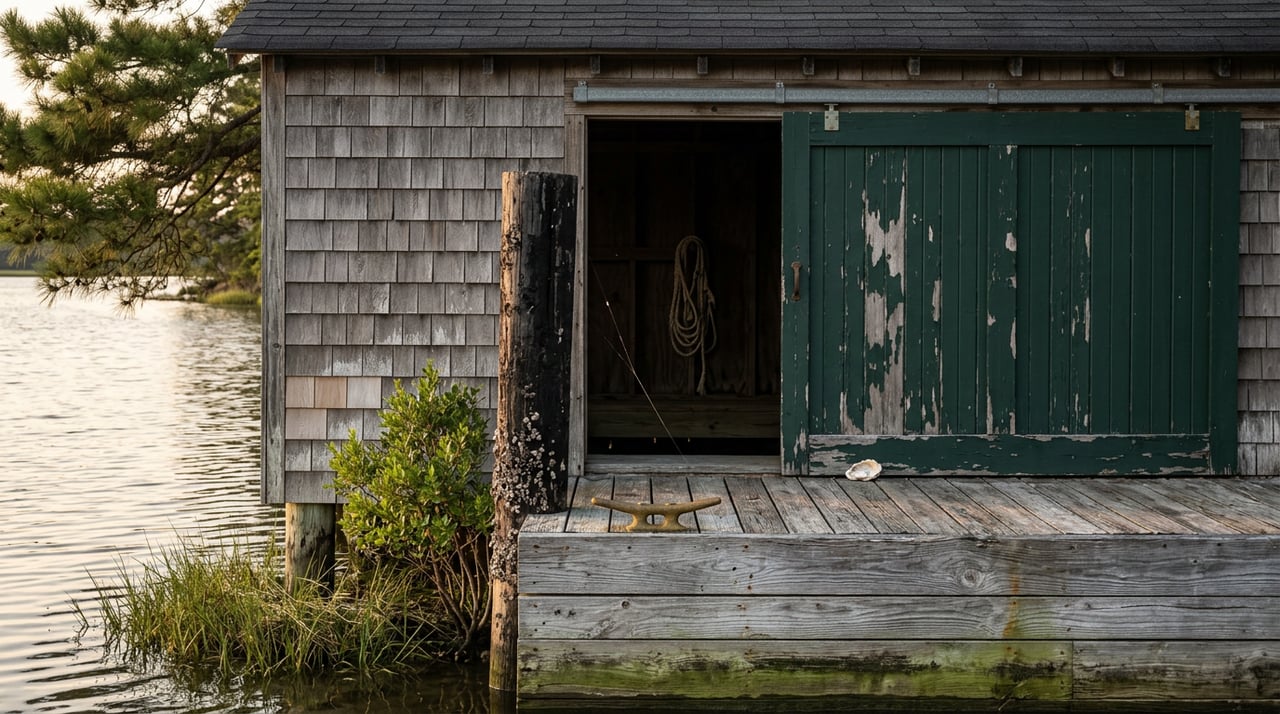
Shady Side Maryland Things to Do Along the Waterfront
August 20, 2026
August 20, 2026
It's a Friday in crabbing season, a little after six, and the gravel lot at Skipper's Pier is already tight. A pickup with a trailer backs into the last open row while, twenty feet away at the actual pier, a deadrise workboat ties off next to a runabout that just came down from the Rhode River. Nobody at the bar seems to register this as unusual. It isn't. This is just how dinner works here.
Ask someone who grew up in a walkable town what a neighborhood's dining scene looks like and they'll describe a strip: a few blocks, a cluster of signs, maybe a night where you wander between three places before deciding. Shady Side doesn't have that, and it never will, because the peninsula itself won't allow it. The land here is a string of coves and points along the West River and Herring Bay, not a grid. So instead of a restaurant row, you get a restaurant per pier: Skipper's Pier Restaurant & Dock Bar on its own stretch of shoreline, Driftwood Diner doing an entirely different job a few minutes off, Pirates Cove and Dockside Restaurant & Sports Bar and Jay's Latin Kitchen each planted at their own bit of water access. You don't cross-shop them the way you'd cross-shop restaurants on a Main Street. You pick the one whose dock, parking, and crowd fit what tonight actually calls for.
The thing outsiders miss is that "where should we eat" and "how are we getting there" are the same question in Shady Side. If you're arriving by boat, your choices narrow to whichever pier has slip space at the hour you show up, which shrinks fast on a summer Saturday. If you're driving, you're choosing a gravel or asphalt lot that fills at a completely different pace depending on whether the place is a destination sports bar or a quieter dinner spot.
| Where | What's actually happening there |
|---|---|
| Skipper's Pier Restaurant & Dock Bar | A working dock bar where boat traffic and car traffic compete for the same waterfront, built around crab cakes and oysters |
| Driftwood Diner | The land-side option, American fare, no dock decision required |
| Dockside Restaurant & Sports Bar | Leans toward the car crowd and a livelier bar scene rather than boat-in dining |
| Jay's Latin Kitchen | The one break from seafood-and-crab-shack norms, a Latin and Mexican menu in the same waterfront rotation |
None of this is a ranking. It's a map of decisions locals already make without narrating them out loud: crab feast tonight or something different, boat-in or drive-in, quiet or loud. The point is that the choice was never really about the food first. It was about the water.
If you've driven past the Captain Avery Museum without stopping, you've probably assumed it's the standard small-town history house, old furniture behind velvet rope, maybe a diorama. It's not that.
The museum occupies a two-story frame house built around 1860 as the residence of Chesapeake Bay waterman Capt. Salem Avery, expanded through the nineteenth century and then again in the 1920s by the National Masonic Fishing and Country Club, which used the property as a retreat before it became a public museum in 1984. The house was listed on the National Register of Historic Places in 2005. But the detail that actually separates it from a dozen other small Bay museums sits in the boathouse, built in 1993: the Edna Florence, a Chesapeake Bay deadrise workboat built locally in 1937. It isn't a model or a reconstruction. It's a boat that fished and crabbed these same waters for decades before it became something you can walk up and look at.
That distinction matters more here than it would somewhere else, because Shady Side hasn't turned its maritime identity into a polished tourism product the way some Bay towns have. The museum keeps public walk-through hours on Sunday afternoons and offers private tours the rest of the week, and the waterfront grounds themselves are available to rent for weddings and family gatherings. It functions less like a static exhibit and more like an extension of the working shoreline around it, which tracks with everything else about how this peninsula operates.
That's not incidental. A short drive from the museum, West River Rigging on Atwell Road handles the unglamorous maintenance side of boat ownership that every marina town needs and few visitors ever see. Bay Hunters Charter Fishing runs trips out of Shady Side from April through December, targeting rockfish and striped bass, white perch, spot, bluefish, Spanish mackerel, speckled trout, red drum, and catfish depending on the month. And near Dunkirk, waterman John VanAlstine works 35 acres of oyster beds on the Rhode and West rivers, selling live hard and soft crabs and seasonal oysters directly, the way watermen here have done for generations longer than any restaurant on this list has existed.
Put those three things next to the dock bars and the museum and a pattern shows up that a lot of neighborhood write-ups skip past: the crab cakes on your plate at Skipper's Pier and the rigging getting serviced two coves over and the workboat sitting in a museum boathouse are not separate storylines. They're the same economy, just visible from different angles depending on where you happen to be standing on a given afternoon.
Not every evening here needs a dock. Shady Side's land side holds its own routine, and it's worth knowing even if you've lived here for years and never made time for it.
None of these require the calculus of slip space or lot crowding that the dock restaurants demand. They're the pressure valve for the nights when the water feels like a lot of logistics and you just want to look at it instead.
Shady Side doesn't read like other Chesapeake towns because it never built the infrastructure that would make it read that way. There's no central strip, no cluster of hotels, no heritage district packaged for a weekend visitor to walk in an afternoon. What it has instead is a working shoreline where the restaurants are named for the piers they sit on, the museum keeps an actual retired workboat instead of a model of one, and the rigging shops and charter captains and independent watermen are still doing the jobs that shaped the place a century ago. That's not a gap in the neighborhood's identity. It's the identity, and it's why picking dinner here has always been less about a menu and more about a dock.
If you're weighing a move to a waterfront community like this one, or thinking about what a Shady Side property is actually worth given how tightly its daily rhythm is tied to the water, Tamara Miller can walk you through what that means for a specific address. Schedule a free consultation to talk through it.
Stay up to date on the latest real estate trends.

Whether you want to buy, sell, or invest in real estate, you need a winning strategy.
1313 14TH ST NW WASHINGTON DC 20005